


Historical Background (APAU to PJTAU)
The foundations of organized agricultural research at Rajendranagar can be traced to the erstwhile Nizam’s regime. The construction of twin reservoirs Himayat sagar and Gandipet under Musi enhanced water availability and irrigation in the surrounding region and contributed to the emergence of Rajendranagar as an important hub for agricultural development. Building upon these early initiatives, the Agriculture Research Institute (ARI) was established in 1928 by the Nizam’s Government to promote scientific rice cultivation and agricultural research, marking one of the earliest organized efforts in agricultural science in the state. Later on, a dedicated rice research station was formed in 1950, which eventually led to the release of HR 1, the regions very first formally released variety. View More
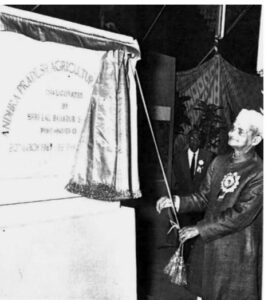
Subsequently, Agriculture and Veterinary colleges established under Osmania University In 1964 to develop skilled manpower for agriculture and livestock development. These colleges were relocated to Rajendranagar in 1955 and the same were inaugurated by Second President of India Sri Sarvepalli Radhakrishnan. First Post Graduate programme in M.Sc. was initiated in 1958 at College of Agriculture, Rajendranagar, Whereas the first Ph.D. programme was initiated in 1975. The Extension Education institute (EEI), originally established as the first extension centre under Osmania University in 1962, was transferred to APAU in July 1964 with the mandate of training middle level extension officers of agriculture and allied sectors throughout the south India.
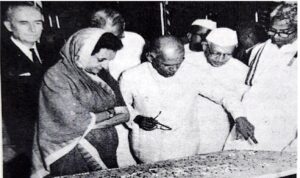
In 1964, responding to the growing need for trained human resources and enhanced agricultural productivity, The Andhra Pradesh Agricultural University (APAU) was established under the Land Grant Model in 2400 acres of lush green land at Rajendranagar. The university holds the distinction of being the second State owned University in the erstwhile- undivided Andhra Pradesh after independence founded On The Land Grant Model, based on Kansas State University’s land grant system. The journey of Andhra Pradesh Andhra Pradesh Agricultural University (APAU) began in1965 with its formal inauguration, on March20, 1965, by the then Prime Minister of India, Shri Lal Bahadur Shastri, who laid the foundation for the institution, which became a cornerstone of agricultural education and research in the state. A year later, in June, 1966, Smt. Indira Gandhi, late Prime Minister of India inaugurated the University’s Building and other infrastructure, and dedicated to the farming community, this building continues as the ‘Centre-Stage Point of Administration’, even till today.
The Andhra Pradesh Agricultural University assumed state-wide responsibility for research in agriculture through the transfer of 41 research stations and 104 research schemes from the State Department of Agriculture in July, 1966. In May, 1967, the University took over the responsibility for research in Animal Husbandry with the transfer of four research stations and eight research schemes from the State Department of Animal Husbandry. The present boys’ hostel (Krishi Nilayam) was inaugurated by former Prime Minister of India Sri Morarji Desai in 1968 and the same is continued to be major facility for accomodation for boys even till today. The first landmark event in terms of use of mass media in agricultural extension programmes by the University took place in 1969 by the establishment of Agricultural Information & Communication Centre (Al&CC) and University Press with financial assistance from Kansas State Univcrsity-USAID (KSU-USAID). The research in Home Science, Fisheries and Animal Husbandry was initiated in 1974 and 1976 respectively..
The university had established first Regional Agricultural Research Station (RARS) at Tirupati in 1979 followcd by RARS, Palem in 1980 to identify and cater the research gaps locally. Recognizing the need to extend classroom and lab-based learning into action at field, the University designed and developed a unique programme for Undergraduates namely Rural Agricultural Work Experience Programme (RAWEP) with the primary objective to learn and experience real farm situations in 1979, which is the first of its’ kind across the country. This innovative RAWE Programme has become role modcl for agricultural universities in India.
Krishi Vigyan Kcndras (KVKs), the one- stop shop solutions for the entire district were designed to bridge the technological gap between research stations and farmer fields by imparting need-based skill oriented vocational trainings were initiated in 1983 and later in mid l998, extension system was re-organized and established District Agricultural Advisory and Transfer of Technology Centres (DAATTCs) in each district,, the existing DAATTCs in Telangana are re-organized and renamed as Tclangana Rythu Vignana Kendras (TRVKs). Recognizing the power of communication through technology like ICT, the Electronic wing was established in 2001 to serve the farming community through electronic media.
Building a Thriving Agricultural Research Hub
The establishment of APAU in 1964 at Rajendranagar, has paved the way for a transformative ecosystem of research and education in agriculture and has made Rajendranagar a hub for numerous national research institutions and initiatives. Recognizing the University’s strategic location, the Indian Council of Agricultural Research (lCAR) initiated exclusive institutions dedicated to leading crops, such as oilseeds, rice, and millets. These institutions were established within the campus of APAU. Many of these institutions proudly collborate with the University to drive Comprehensive agricultural advancement.
The Transition from APAU to PJTAU
APAU was renamed as Acharya N. G. Ranga Agricultural University (ANGRAU) on November 7, 1966,In the honour of Acharya N.G.Ranga, a legendary parliamentarian, former leader and a prominent freedom fighter. The growing need for specialized research and training areas like Animal husbandry and horticulture Led to the decision to establish independent Universities dedicated to these fields. Consequently, ANGRAU underwent a major reorganization, resulting in the creation of the Sri Venkateswara Veterinary University (SVVU) at Tirupati In 2005. Two years later the Andhra Pradesh Horticulture University (APHU) was established at Tadepalligudem in 2007. The division of ANGRAU into three Universities was a transformative step, reflecting the increasing complexity of agricultural sciences.
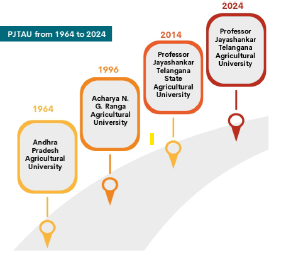
In 2014, following the bifurcation of Andhra Pradesh, ANGRAU at Rajendrangar was reorganized and renamed as Professor Jayashankar Telangana Agricultural University (PJTAU) in honour of Professor Jayashankar, an ideologue of Telangana.The period from 1964 to 2014 marked a significant transformation, as the Andhra Pradesh Agricultural University (APAU) of united Andhra Pradesh evolved into five more distinct universities, addressing the agricultural, veterinary, and horticultural needs of both Andhra Pradesh and Telangana.