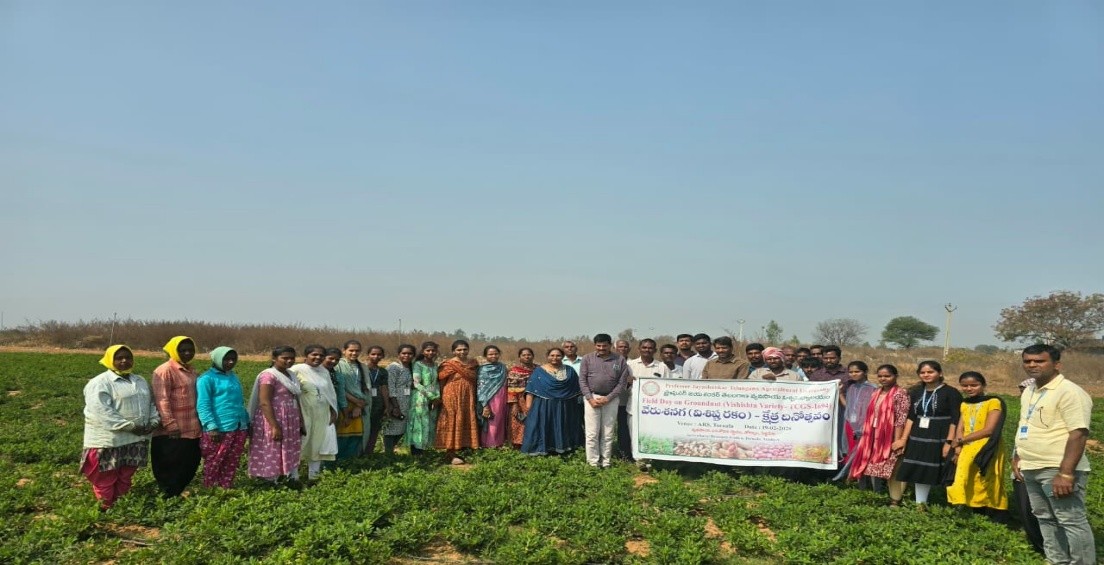
Field day on Groundnut Variety Visistha (TCGS-1694)” by Agricultural Research Station, Tornala on 19-02-2026
A field day on Groundnut variety Visistha (TCGS-1694) was organized at ARS, Tornala on 19-02-2026 by Agricultural Research Station, Tornala. In this programme, Dr. G. Santhosh Kumar, Scientist (Agro.) and Head, ARS, Tornala, explained the scope of cultivating alternative crops to rice during the rabi season, emphasizing their economic feasibility and the role of oilseeds in crop diversification. He discussed the performance of groundnut variety ‘Visishta’ and its suitability for rabi cultivation under local agro-climatic conditions. He also explained its yield potential, pod and haulm yield performance, seed characteristics and market preference. Dr. D. Swetha, Scientist (Agro.), ARS, Tornala discussed in detail the production technologies of rabi groundnut including optimum seed rate of 120 kg pods per acre, recommended spacing of 22.5 × 10 cm, and balanced nutrient management with 40:40:50 kg N:P₂O₅:K₂O per hectare. Weed management practices and mechanization options were also discussed. Dr. A. Ramadevi, Scientist (Ento.), ARS, Tornala explained the major insect pests of groundnut such as leaf miner, tobacco caterpillar, aphids, thrips and root grub, and their integrated management practices including installation of pheromone traps (4–5 per acre), seed treatment and need-based plant protection measures. Mrs. A. Saritha, Scientist (Breeding), ARS, Tornala explained the varietal characteristics of the groundnut variety and its suitability for the agro-climatic conditions of the region. Mrs. G. Neelima, Scientist (Breeding), ARS, Tornala explained field management practices adopted in rabi groundnut cultivation for maintaining optimum plant population and achieving higher productivity. Dr. B. Bhanukiran Reddy(SSAC), ARS, Tornala explained about the importance of applying gypsum @ 500 kg/ha at flowering/pegging stage for better pod development and the role of micronutrients such as zinc (ZnSO₄ @ 25 kg/ha) in improving productivity. He also explained irrigation scheduling, mentioning that groundnut requires 450–600 mm of water and that flowering, peg penetration and early pod development are critical moisture-sensitive stages. During the interaction session, farmers raised various issues related to groundnut cultivation and scientists provided suitable technical recommendations. The programme was attended by 40 farmers from Siddipet district.